Enough Said

Enough Said

-Film Reviewed by Lisa Umhoefer

Enough Said explores the life changes that parents face when sending their kids off to college. Eva (Julia Louis-Dreyfus) is a divorced mother. She must balance her job as a masseuse while trying to cope with her daughter’s departure from home. Unbalanced by the sudden change, she seeks a fresh start.

The film was one of James Gandolfini’s last projects before his death, adding a new dimension to the career of this beloved actor. Gandolfini stars as Albert. When Eva meets him at a party she attends with her friends, Sarah and Will (Toni Collette and Ben Falcone) she has already made the mistake of declaring loudly that there is no one at the party to whom she is attracted. Albert proclaims the same in a sweet effort to mitigate some of her embarrassment and the smiles they exchange establish their budding affection.

The first date is a success. Albert plays a believably, sweet, teddy bear of a man and Eva is clearly smitten. Complications arise, however, when it turns out that one of Eva’s massage clients, Marianne (Catherine Keener), is also Albert’s ex-wife. This awkward revelation comes after Eva has listened to a series of damning complaints from Marianne about her ex-husband that she agrees sound awful. Now Eva realizes she is dating the source of her client’s aches and pains.

Being Marianne’s friend, while dating the biggest source of her unhappiness, proves difficult. But Eva can’t help herself. She has given into the temptation to gossip about Albert, and soon Marianne’s opinions of her ex-husband are influencing her own first impressions. Eva begins to see only Albert’s flaws, adopting Marianne’s pet peeves and standards. This leads to an inevitable confrontation in the worst possible scenario, and we witness Eva walk away like a wounded puppy with her tail between her legs.

A superb script, Enough Said makes some powerful observations of human behavior and comments on the many ways that people can err in their relationships. One of the most uncomfortable scenes transpires at a dinner party put on by Will and Sarah for Eva and Albert. Eva bullies and berates Albert in front of her friends pointing out the different faults that she and Marianne have zeroed in on. Audiences sympathize with Albert. Viewers will also wonder how much of Eva’s complaints are really based on her own feelings, and what impressions and misimpressions are the fault of her association with Marianne.

The film portrays the uncompromising nature of people. When one of Marianne’s chief complaints about her ex-husband was that he did not have end tables for his bedroom, Eva finds herself making the same complaint. Stubborn, Albert still refuses to act. Ultimately, he and Eva reach a resolution only because Eva abandons her wishes on this issue, not because Albert makes an effort to change or accommodate her desires.

The message is clear: the only way to happiness is to lower expectations. Audiences recognize, however, that this is probably not a sustainable solution, and they will be critical of the action when it appears that Eva and Albert are merely making another cycle through the obstacle course of dating, divorce and recovery. Unfortunately, lopsided relationship compromises contradict the spirit of the film. As the actors try to convey happiness, there is underlying sadness and resignation that complicates their situation and moods.

Enough Said is the fifth film feature written and directed by Nicole Holofcener, who is also an accomplished TV director. Audiences will appreciate Holofcener’s finesse crafting scenes where characters painstakingly digest new events in their lives. One feels on the set or in the room with Albert and Eva, and the drama connecting them and dividing them as a workable couple feels real.

In a world of slam, bam action movies, it is a luxury to watch the non-rushed, nuanced performances that Julia Louis-Dreyfus and James Gandolfini deliver. Enough Said is a well-packaged work that is worth a view even if in the end happiness is just a matter of settling.


Post Photo Courtesy of http://www.fastcocreate.com

The Other Side Of Pali

"The Other Side of Pali" By Emily Lee

“The Other Side of Pali” By Emily Lee

The Other Side of the Pali

Book Reviewed By Roger Market


The Other Side of the Pali is a wonderful short story collection written and designed (in paperback form) by Emily Lee. The book’s cover is deceptively simple, but it is also inventive and breathtaking. The overlapping colors brought on by ripped pages are expertly placed, as if by a trained graphic designer. Which makes perfect sense because Lee is a graphic designer, too. Suffice it to say, this is no ordinary self-published book.

It starts with “Two Views of the Sea,” an otherworldly and yet very real tale of Hawaiian sisters Margaret and Ginny. When Margaret discovers an old Hawaiian myth, the sisters go on an underwater adventure together but still manage to have completely different experiences. This is a story steeped in myth and the idea that twins are not carbon copies but individuals in their own right. At age fourteen, Margaret and Ginny still have plenty to share, but now they are veering off, separately making discoveries about the world and themselves.

“The Other Side of the Pali,” the title story, appears later in the book. It is yet another tale of Hawaiian sisterhood, but this time, it’s serious. This time, the sisters involved are all grown up, and they’re dealing with the iniquities that come with age. On a purely emotional level, this story stands out. Easy criers should bring tissues.

“Sugar,” which is easily one of the most depressingly hilarious views of old age I’ve ever seen, brings on the laughs in a big way. The phrase “some things never change” is a bit of a cliché today, but in this story, it’s definitely true. The reader won’t believe how far these old friends and competitors will go to one-up each other. I’ve read the book several times, and I laugh out loud at this story every time.

“Cast-off String” is a beautiful vignette detailing the remnants of a lost love, as well as a burgled home that now “hums with someone else’s energy.” Despite the sorrow that permeates the first half of the story, the last line is so airy and delicate that it reinvigorates the reader, lifting him or her back up like the feather at the end of Forest Gump.

“Doctor of Restraint” takes a turn for the creepy, as a young doctor-in-training finds himself trapped with his mentor in a horror show of medicinal history. This story stretches believability a bit thin, however, as does “The Critique.” While these stories are not among my favorites, I love that they still manage to do what the rest of the book does on a fundamental level: present the two sides of a duality so crucial to the human experience. Fear and confidence, life and death, comedy and tragedy, sanity and insanity, Lee is consistent in her approach to storytelling, and the book ties together well.

“Rorschach Ink” is perhaps the most unrealistic story of the collection—but deliciously so. Readers may groan at the thought of reading a story about therapists; however, they should stick with this one. Here, Lee shows that borderline magical realism may be the key to a good, or at least interesting, therapist story.

Lee also has a gift for creating and relieving tension. Her wonderful sense of pacing fuels my appreciation for the penultimate story: “Balloon Ride.” If the stories in this book have been building up to something, this is it: the heartbreaking story whose final line will have the reader gasping at what just happened, yearning for more but feeling satisfied all at once.

The last story in the collection, “‘Ilima Lei,” takes the reader back to Hawaii for one last look at the culture that has clearly stolen Lee’s heart and underscores not only the book’s title but also its energy. In this story, Lee yet again takes an often-belittled element, the dream sequence, and provides something so refreshingly beautiful and frightening that the reader will wonder why it was ever considered a cliché. Alana of Ka‘a‘awa is Hawaii’s mute treasure, and it is perhaps her final scene that best evokes the Hawaiian feel of the book and brings it to its natural close.

And then the reader has nothing to do but literally close the book and feel that painstakingly designed square form in his or her hand. A perfect fit for short stories.

***

Tawk Tomahawk


Tawk Tomahawk

-Album Reviewed by Jake Kresovich


Bands rarely sweep you off your feet with mellow, entrancing vibes that beg to be put on repeat in the same way as Hiatus Kaiyote. The four-piece band from Melborne, Australia has a sound reminiscent of Erykah Badu’s emotionally driven compositions. Led by front woman Nai Palm, Hiatus Kaiyote put forth their debut album, Tawk Tomahawk, earlier this year.  Although the album didn’t get much attention upon its first release, the music found its way to the right ears. With encouragement from Questlove and other well-respected musicians, the band re-issued Tawk Tomahawk under Sony Masterworks’ imprint, “Flying Buddha.”

The album fades in with a guitar riff that slowly takes form as a drum beat falls in underneath. Layered on top, Palm’s voice guides the direction of the melody. “Mobius streak” welcomes the listener with a warm melody that is uplifting albeit restrained, setting the tone for the album.

In the ensuing songs, the music becomes more confrontational. The short tracks of “Ocelot” and “Boom Child” explore coarse and heavy melodies but pleasantly retain a hint of Palm’s soft voice.

The album reaches its crescendo with the song “Lace skull.” Here, Palm’s voice loses its aloofness from earlier in the album and grows more assertive. No longer does her expression feel like an accent to the music. She is the driving force. This change in direction is further emphasized by an upbeat tempo from the rhythm section.

Intermission? Listeners relax as two instrumentals return the mood to a more sedated state reminiscent of the album’s intro. The respite is necessary to prime us for what’s ahead:

“Nakamarra” rounds out the album with a beautiful, heart-warming ballad. Palm’s uplifting voice again takes control. She sings of her admiration for her friend Hannah and the artist Doreen Nakamarra, an influential Australian artist known for her work with mentally disabled Aborigines. Her words and tone float like a bird flying freely in the wind, inviting anyone along for the ride. She repeats, “I love you, I love you, I do…” in a tone that draws in, embraces and warms the listener.

Tawk Tomahawk is beautiful album that invites listeners on a journey. This album begs to be played front-to-back, again and again. The future-soul style of Hiatus Kaiyote draws from music legends, improvising and adding unique emotions to the score that can’t be duplicated. Those looking for a pleasing escape into a picturesque world created by sound need look no further. Hiatus Kaiyote strikes the right chords and melodies.

Post Photo Courtesy of: http://www.u-fm.it

Orphans

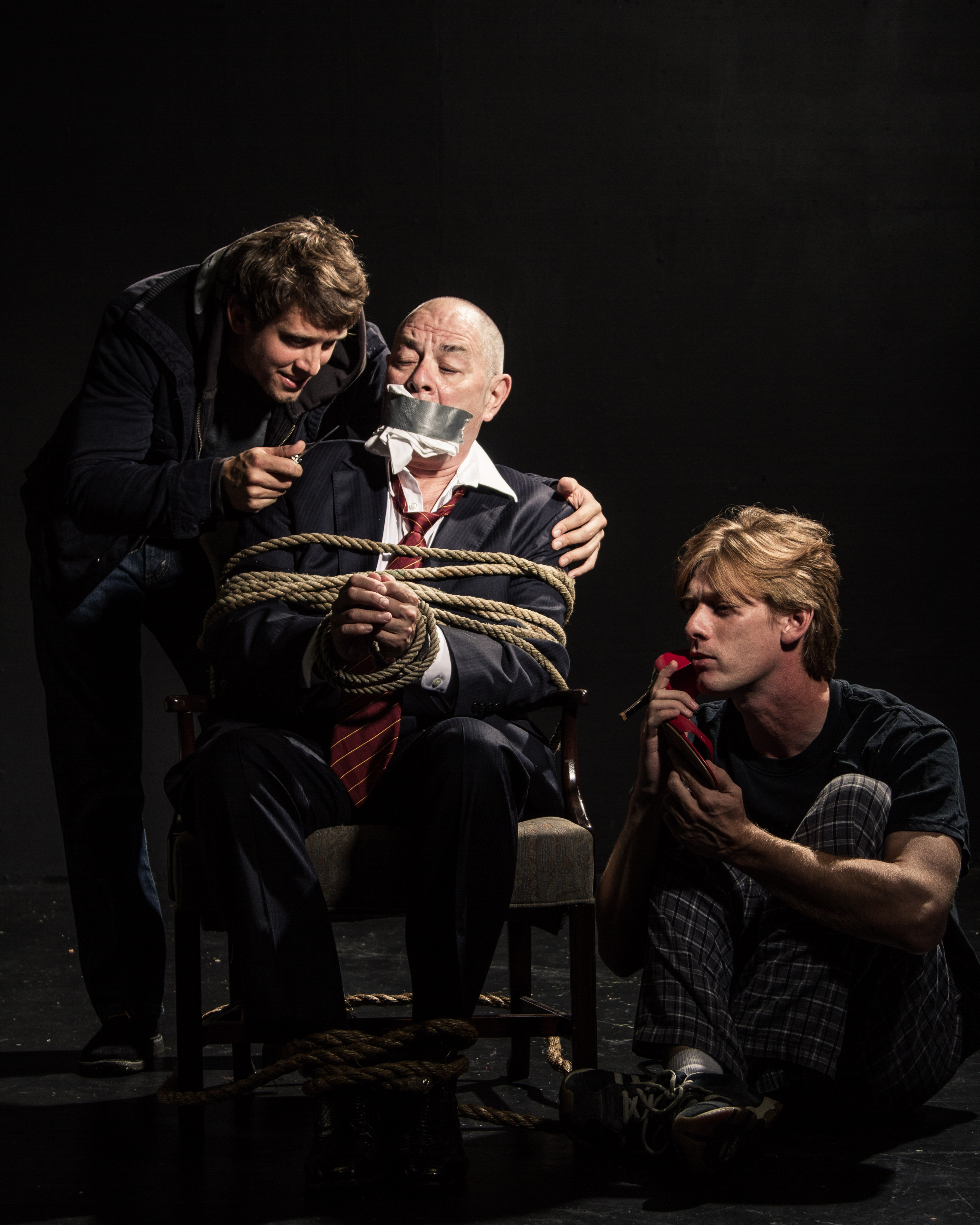
David Shoemaker, Eric Park and Jeff Murray in "Orphans" Photo Courtesy of Ken Stanek

David Shoemaker, Eric Park and Jeff Murray in “Orphans” Photo Courtesy of Ken Stanek

Orphans 

– Theatre Review by Rachel Wooley

When life’s circumstances leave someone orphaned, how long does the term “orphan” apply? Does a person outgrow the label once they reach adulthood? How do they get past the hole that the absence of a loving and supportive parent leaves in their lives?

In Orphans, now playing at the Fells Point Corner Theatre, all three of the play’s characters grapple with this last question. Treat and his younger brother Phillip live together in the old family row house. Their father has abandoned them and their mother has died. They survive on a diet of Starkist tuna and each brother deals with the ramifications of their family’s tragedy a little differently. Phillip, who is played with incredible skill and delicacy by David Shoemaker is essentially a shut-in, hindered in part by his nervous tics. Much of Phillip’s reclusiveness is self-induced, but his older brother, Treat (Eric Park), makes sure Phillip remembers that the outside world is a hostile place. In his misguided attempts to protect his younger brother, Treat encourages Phillip’s behavior and even refuses to let him learn the alphabet or how to tie his shoes.

But Treat can’t be home to watch Phillip all the time. He is the breadwinner of the family, making a living through petty theft. When Treat returns home and proudly shows off his collection of stolen jewelry, watches, and wallets, Phillip is uninterested in the loot. The curious younger brother prefers to hear about the people Treat has encountered outside.

The FPCT crew has created an incredibly detailed set to accompany the show. Throughout the messy row house where the play takes place, a few of Phillip and Treat’s mother’s things remain, including one red stiletto that Phillip harbors obsessively. Treat, meanwhile, threatens to discard these items. They “ain’t doing nobody any good,” he says, forcing Phillip to throw the partner-less shoe out the window. Phillip is taunted by the shoe’s presence on the lawn, however, and can’t resist retrieving the memento of his mother.

The situation becomes more complicated for the brothers when Treat decides to give up his career of hold-ups and jewelry theft in order to take on something more lucrative: kidnapping. Enter Harold (Jeff Murray), his first victim.

David Shoemaker as "Phillip" and Eric Park as "Treat" in "Orphans." Photo Courtesy of Ken Stanek

David Shoemaker as “Phillip” and Eric Park as “Treat” in “Orphans.” Photo Courtesy of Ken Stanek

Things don’t go as planned. When Treat phones Harold’s office to demand ransom, nobody believes that Harold has been kidnapped. In fact, nobody seems to care what happens to him. Meanwhile, Harold worms his way out of his poorly-tied ropes and befriends Phillip, who’s supposed to be watching him.

Once freed, Harold considers the desperation of his captors and decides not to leave. Instead of viewing Treat and Phillip as villains, Harold sympathizes with the sad state of the two abandoned boys, who are clearly in need of a father figure. Harold, who was an orphan himself, is obsessed with caring for what he calls the “Dead-End Kids.” He quickly sets Treat up with a job and a salary that’s great even by today’s standards (the play was written in 1983).

Within two weeks, change is evident. The boys’ house is clean, and cans of Starkist tuna have been replaced with Harold’s homemade meals. Harold is adept at  approaching each of the boys individually because he sees himself reflected in each of their personalities. To coax Philip out of his shell, Harold buys him a pair of loafers without laces. He also circles their home on a map of Northern Philadelphia to ease Phillip’s worries about getting lost should he finally go outside.

Treat, however, is more complicated. New clothes and the promise of money and women entice him, but Treat’s tough persona doesn’t leave much room for Harold’s emotional encouragement.Treat’s attempts to overcome his rage (with Harold’s help) leave him struggling and confused. Complicating matters, Treat senses Phillip’s growing allegiance to Harold and feels displaced. “Don’t I always take care of you?” he demands of Phillip.

Jeff Murray as "Harold," Eric Park as "Treat" in Orphans, Photo Courtesy of Ken Stanek

Jeff Murray as “Harold,” Eric Park as “Treat” in Orphans, Photo Courtesy of Ken Stanek

Harold, meanwhile, has his own problems. Aside from loneliness, he’s haunted by a dark past, and some shady business dealings he left in Chicago. Nevertheless, Harold (perhaps owing to Murray’s skillful interpretation of the role) is somehow always genial with the brothers, even when he’s waving a gun in Treat’s face.

This story, though full of beautiful moments, can only end tragically. Both the brothers’ and Harold’s lives are irrevocably changed in the course of the show, and Director Steve Goldklang has skillfully woven their performances together, arriving at an incredibly moving conclusion.

The show is gritty, but moments of humor layer and accent the personalities of the three characters, deepening their relationships. The contrast of intense confrontational scenes with lighthearted and tender moments keeps audiences engaged in the trio’s emotional journey until the bitter end. Audiences will appreciate the characters’ explorations of what it means to be family and the intricate and unexpected bonds that can form between human beings.

Orphans is showing at 8:00pm Fridays and Saturdays and 2:00pm on Sundays. There are also two Thursday evening shows, November 14 and 21, also at 8:00pm.

Post Photo Courtesy of Ken Stanek

America Is Going Street

Photo Courtesy of: http://www.daz3d.com

Photo Courtesy of: http://www.daz3d.com

America is Going Street

Fashion Report by Dorothy Chan and Kendra Bartell 

America is going street. Miley has moved her address from sweet pop Nashville to twerk hip-hop queen with grillz and a Jordan swimsuit to match. Beyonce and Jay-Z are music’s it couple. Rihanna is dominating both the billboard and fashion charts with her provocative lyrics and her even more provocative outfits. Pictures of grillz are dominating tumblr. Yes, hip-hop has officially become the influence of our generation—it’s the byproduct of America, from our music to our fashion to our lifestyles. As Pharrell Williams puts it, we’re “injecting dressed-up luxury into hip-hop style and thereby influencing a new generation of guys to consider more than just a pair of baggy jeans a reflection of their youthful vitality.”

Streetwear has become the trend for at least a few seasons now. Since Givenchy debuted its Rottweiler sweatshirt (tee version available here), high fashion has been going from couture to street and back and forth. Today, brands such as Givenchy, Rick Owens, Yohji Yamamoto, and Marc Jacobs dominate the runways. These brands have a casual, yet high end, tough yet effortless vibe to them. Black is in more than ever. Leather is in more than ever. Sweatshirts, bomber jackets, sneakers, beanies, and snapbacks are back in. It’s the 90s + hip-hop + couture + an x factor of fashion. What’s behind the resurgence of these styles?

We’ve all seen the couture outfits debuted on runways, but how does the presentation of high-end designs actually influence our lives? Streetwear in Asia and America is a global phenomenon. The terms streetwear and street fashion are generally used to chronicle what everyday people wear on a regular basis. Streetwear started from the surf culture of the 1970s, and was further influenced by skate culture, hip-hop and Japanese fashion  It’s about looking tough rather than preppy and polished on the streets. There’s also an unabashed element of color. In summary, it’s not “stiff.” Here are a few examples, and please note that streetwear is also big in Asia.

If Comme des Garçons and Bape are breaking the bank, you might want to try cheaper options. Luckily, high street stores such as River Island and Urban Outfitters are offering plenty of alternatives. In fact, streetwear’s influence seems to have climbed up the ladder of social importance so high that it’s now entering the trickle down phase. Popular clothing store Forever 21, known for its cheap imitations of high fashion lines, has been upping its streetwear game, seemingly imitating all it can get its hand on. Now, that’s not necessarily a bad thing—girls on a budget want nice digs, too—but it is an interesting phenomena. Streetwear was once actually associated with people on the street, the cultures we like to ignore and look over—the minority culture white America tries so hard to distance itself from. What does it mean that now, one of the major shopping stores for middle-white America is producing affordable streetwear (with a majority of white models)? Is it appropriation for Forever 21 to sell “Lounge easy sweatpants” that are almost a direct knockoff of Rihanna’s River Island Collection’s “Embossed Leather Pants” only a little comfier? What does it say about our culture and the way streetwear has entered high fashion’s consciousness now that Rihanna has designed a major line that is already almost all sold out online?

Photo Courtesy of: http://www.graziadaily.co.uk

Photo Courtesy of: http://www.graziadaily.co.uk

Rihanna’s River Island Collection is an interesting case study in the proliferation of high-fashion streetwear. River Island is a London based high-street store with a number of worldwide markets. Its physical stores are mostly in Europe, but thanks to the world wide web, we can purchase their clothes all over the world. Rihanna’s line, however, seems to know who its audience is. It’s not just those normal high-fashion customers, its also her biggest fans, who may not necessarily be the wealthiest fans. Her line offers a range of price points. A majority of the “bigger” items, that is, the maxi dress, the leather pants, are in the $300 range, but there are also some affordable prices. The Midi Skirt is only $100, and the Stripe Cropped Sweater is only $87. While these are not Forever 21 prices, they’re not fashion house prices either. Rihanna herself is doing a great job of marketing this streetwear collection to those who wouldn’t have known it was a phenomenon–that is, her more sheltered fans. Those who follow Rihanna on instagram and twitter, however, cannot escape the pictures of her dressed in her own collection items, taking advantage of the marketing opportunity. It worked, though, and a lot of modestly priced items are already sold out online, with the option to try and find it in stores.

Another retail giant to middle-class mainstream American markets is the ubiquitous Urban Outfitters. They are taking a similar marketing strategy to Rihanna and River Island, but seek middle line prices. The general consensus is that Urban is a bit “classier” and better made than Forever 21, so their primary market are people who care about the quality of their clothes a little more and are willing to shell out a bit more dough for the name connotations. Their tactic is to seem better put together and appeal to price/ vs. quality concerned consumers. However, their basic pattern is the same: sell streetwear to the people. They sell a similar Army Pant to what Rihanna is selling, but at the modest price of $59 (here). They even have a whole tab dedicated to hoodies and sweatshirts, bordering the line between streetwear and “high” fashion. Some hoodies are dedicated to repping cities (See Chicago, New York), while others are mixed materials of lace and jersey.

Women remain the main consumers of the fashion industry, so while streetwear has its masculine appeal, the job of fashion houses and high street brands is to make it appealing to women. How or why exactly is streetwear appealing to the contemporary fashionista? The biggest fashion icons in history (think Audrey Hepburn and Princess Di) were known for their feminine style. But today, tomboy is in. Perhaps as the image of the independent woman is solidifying, fashion is changing with it. If men can dress as dandies, women can dress as tomboys—it’s a fun balance of the masculine and feminine in everyone.

Besides, some of the most influential women in fashion are embracing the whole tomboy chic/streetwear trend. Model of the moment Cara Delevingne (check out her instagram) is a self-proclaimed tomboy who plays the drums and gets tattoo after tattoo. She also recently opened up about her dating life, “I’m done with boys, they’re so annoying, all they care about is their willies. I want to behave more like a boy,” she says.

Like her friend Cara Jourdan Dunn, another popular model, is embracing the streetwear trend. Check out Cara and Jourdan cooking in onesies and Brian Lichtenberg (the guy who mocks designers with his famed Homies sweatshirt) here—a perfect mix of feminine activity and tomboy streetwear.

Supermodels aren’t the only ones sporting this trend. Fashion bloggers are emulating streetwear and tomboy chic as well. Jane Aldridge of Sea of Shoes is as well known for her 50s skirts as she is for her love of sweatshirts, leather, and menswear-inspired pieces. Top model judge and blogger, Bryanboy is also no stranger to Givenchy’s streetwear-inspired sweatshirts.

The proliferation of streetwear up and down the fashion markets poses a range of interesting questions about cultural appropriation in the fashion culture of America today. The wide-ranging options of price points one can shop at and still rock this major trend is just one piece of evidence that this streetwear fashion trend is here to stay. Racial and gender issues are no coincidence to the trends that are emerging with streetwear. After all, America is now a hip-hop embracing nation giving birth to independent girls and fashion-forward guys. Streetwear is the new “Think rich, look poor.”

Post Photo Courtesy of: http://www.daz3d.com

600 Strangers: Book Tour Encounters

600 Strangers: Book Tour Encounters

-Reported By Jeffrey F. Barken


When I published the first edition of my book, This Year in Jerusalem, I printed 600 copies. During the final print inspection, I watched sheets of paper be fed and carried by conveyor belt through the various processes of a room sized press. Stacking up on the opposite side were the olive green, matted, front and back covers that I had designed, ready to be folded around the pages of my book. As excited as I was to see my work printed, I was also nervous. In the instant that I pressed print, I committed myself to meeting 600 strangers.

"This Year in Jerusalem" Front and Back Cover

“This Year in Jerusalem”
Front and Back Cover

Five months later, I’m shocked to discover that I’ve already met over 300 people. On my travels through Europe and Israel, I’ve encountered students, fellow writers and travelers, professors, hostel workers, soldiers, and families. Many have told me they think we were “meant to meet.” When this happens, I always think back to the scene at the printer’s, where I first committed to this course.

The best part about having sold so many books is that many people are keeping in touch and providing feedback. Beyond my love of words and storytelling, this was always my reason to write. I was curious whom I’d meet through the act of publishing and eager for the exchange of ideas that only books can prompt. When I ran into Dutch Author, Anouk Kemper on her last day in Tel Aviv, therefore, I knew we’d have a lot to discuss.

Anouk’s debut novel, De Almeerse Rioolmoorden, (the Eventful Year of Hans and Lilly Mulder) tells the story of Hans Mulder and his adopted daughter Lilly. Hans is a journalist writing about the ‘Sewer Murders’ in his hometown Almere, near Amsterdam. When Hans finds out that his daughter has something to do with the killings, a bizarre cat and mouse game between these two people, who will always be connected to each other, whether they like it or not, ensues.

Anouk Kemper

Anouk Kemper

Not speaking Dutch, I was disappointed that Anouk and I couldn’t trade books. She, however, took a copy of mine and promised to send me some more information about her writing upon her return to Holland. Anouk devoured This Year in Jerusalem on the plane, and we were soon trading stories about the writing life in our respective countries and our personal ambitions as novelists. The following interview sheds light on Anouk’s writing process, some of the great untranslated literature that English audiences are missing out on, as well as an insider’s perspective of the publishing industry in Holland:

Interview With Anouk Kemper

Jeff:  De Almeerse Rioolmoorden was nominated for a prize and has received a lot of attention in Holland. Where did you find the inspiration to begin the project?”

Anouk: “First of all, in my hometown. I live in Amsterdam now, but I grew up in Almere. A new, modern and very boring place 25 kilometers from Amsterdam. I was also very inspired by films like American Beauty and The Omen. In the first film Kevin Spacey plays Lester Burnham, a 40 year old man who is having a bit of a midlife crisis. I really like his cynical sense of humor. Lester was a big inspiration for my main character, Hans Mulder. The Omen was also inspiring, because it’s about two parents who raise a kid that is not their own. You never know what kind of person you let into your house and the same is true for Hans when he adopts Lilly from Vietnam. Later on he starts to realize that there is something very, very dark about her nature.”

Jeff: “Can you translate the title and first line of your book for English audiences?”
Anouk: “It’s hard to translate literally, because I don’t know how the translate ‘Almeerse’. I think it must be something like:
“The Almerian Sewer Murders.” And The first line is: ‘That is why I hate obituaries so much.'”

Jeff: Can you describe some of the principal characters in your book? How do their mannerisms, faults and quirks help advance the plot and add texture to the narrative?”

"First Lines and Anouk Reading" Photo Courtesy of Anouk Kemper

“First Lines and Anouk Reading” Photo Courtesy of Anouk Kemper

Anouk: “Hans Mulder is a journalist of 56 years old. He lives in Almere with his very succesfull wife, she is an anchorwoman for the national television. Hans is cynical, sceptic and has accepted the fact that his life is pretty insignificant. His daughter Lilly is 23, lives in Amsterdam with her way older, criminal boxer boyfriend. She is completely egocentric, inscrutable and a sociopath. I’ve told the story from both their perspective, alternately. So the first chapter is from Hans’ view, second from Lilly’s, third is Hans again, and so on.  This alternation worked as a puzzle, that came more and more together after each chapter. It also made it possible to use two different tones of voices.”

Jeff: At what point in the writing process did you realize you knew how the book would end?”

Anouk: “I already knew how it would end before I started writing. For me the ending was inevitable. It had to happen like that.”

Jeff: How long did the book take to write?”

Anouk:I finished the first draft within 4 months. It took another two months before it was finally done.

Jeff: “What was the most challenging aspect of writing your first book?”

Anouk: “Finishing it. I worked on a lot of stories, but I was never able to finish them. I just lost my motivation after 10 pages. Also, I didn’t have enough to tell. Who does in his/her teenage years?”

Jeff:  “Have you been surprised by the press your book has received?”

Anouk: Yes. It got a lot of attention. I gave a lot of interviews, was invited to a lot of events and everybody was constantly asking me about the book. It felt like a thunderstorm, so it took me some months before I could really enjoy everything that had happened.”

Jeff: “How has your worldview, and your writing process changed now that you have begun writing a second novel?”

Anouk: “I have a less romantic view on writing and publishing. It’s a business, an industry and people want to make money out of it. When I was working on my first book, I wanted everything to go fast. I didn’t really feel like taking a bit more time to think about what I wrote. Now that I’m already published I feel less time pressure. I realized it’s ok to work on a book for over a year. And I finally ‘discovered’ my own style. It was there already, but now it truly feels like I have a ferm grip on it.”

Jeff: “In what ways are you experimenting? Did you feel like you needed to make safer choices in your first book?”

"Anouk, Writing" Photo courtesy of Anouk Kemper

“Anouk, Writing”
Photo courtesy of Anouk Kemper

Anouk: “In my first book there was lot’s of stuff going on, lot’s of crazy stuff: weird people, drastic plot lines, etc. It was all a bit over the top. According to the publisher it was a bit like a Tarantino film.  Now I am writing a much ‘smaller’ story, way more true to life. I don’t feel like I have to lean on the plot that much anymore, because my writing in itself got better.”

Jeff: “Please tell us about the literary community in Holland. How accessible are writers to their audiences? (What role does social media play in terms of generating book talk?)”

Anouk:Writers are pretty accessible, I think. Especially in Amsterdam there are a lot of literary events, where writers and readers can meet each other. Social media are important in the sense that they announce the events, of course. Also, readers can easily contact writers, who use Facebook and Twitter as their personal mouthpiece.”

Jeff: “What is the process like to publish a book in Holland? (editors, agents, publishing houses etc.)”

Anouk: “It’s all about knowing people. I once wrote an article about young writers and one of the people I interviewed, told me that only one out of a 1000 comes in through the front door. All the others got in by knowing people that know people. If you want to be published, you have to go out and network. That’s also what happens at the literary events. It’s not only a place for the ‘normal audience’, a lot of editors go there as well.”

Jeff: “How do you get your book translated?”

Anouk: “A Dutch book only gets translated if it was a bestseller in the Netherlands. Like The Dinner by Herman Koch, Bonita Avenue by Peter Buwalda and The Discovery of Heaven by Harry Mulisch.”

Jeff: “What does the term “break out book” mean in Holland? Do most Dutch writers dream of having their work translated?”

Anouk:I never heard any one really talk about wanting to be translated. The first dream is: selling well, getting a second or even third print. Being translated is way beyond expectation. I think the chances of getting a film adaption is bigger. That’s already a huge deal, a translation comes a couple of steps after that.”

Jeff: “Movie rights? What books get made into movies in Holland and should we be on the look out for a great foreign film?”

Anouk: Again: bestsellers get a film adaption. Well, some.. not all of them. At the moment The Dinner by Herman Koch is made into a movie. Cate Blanchett is the director, so that is really cool! Be on the look out for that…”


"boek in winkel" Photo Courtesy of Anouk Kemper

“boek in winkel”
Photo Courtesy of Anouk Kemper

Jeff: “What types of characters are you most attracted to in your writing? And who are your influences as an author? Is there a time in Dutch literary history for which you’re nostalgic?”

Anouk: Although I am 27 and a girl, I find it way easier to write about middle aged men. I think they can be tragic in a comical way, it’s a starting point I like to work with. The whole tragic-comic thing does not work the same with women or younger people. Not for me, anyway. Maybe that’s why I like Paul Auster and Michel Houellebecq so much. They are the masters of writing about this type of men. Another big inspiration is Bret Easton Ellis. His work shows that your main character doesn’t have to be trustworthy as a narrator. I also like Chaim Potok a lot, I always feel immediately attached to his characters. I like his calm way of telling stories.”

“A time in Dutch literary history for which I’m nostalgic? Hmm, not really. I have to admit that I mostly read American writers. I don’t know why exactly. The other week I promised myself to start reading some great Dutch writers, such as Gerard Reve, Willem Frederik Hermans and Simon Carmiggelt. It starts to be a bit shamefull that I haven’t yet…”

***

To read more about Anouk Kemper, visit http://www.overdose.am

Company at the Vagabond

Photo Courtesy of Ken Stanek

Photo Courtesy of Ken Stanek

Company at the Vagabond

-Theatre Review by Rachel Wooley

Company, a musical now playing at the Vagabond Theatre in Baltimore, was written by George Furth, with music and lyrics by Stephen Sondheim. First performed on Broadway in 1970, the show has appeared in many big name theaters, including the Kennedy Center in DC in 2002. The Vagabond Players stage is a smaller venue than the show is usually performed in, but the actors make excellent use of space for the song and dance numbers, thanks to choreographer Ernie Richie and director Eric J. Potter.

Bobby, the central character (played by Vagabond veteran Tom Burns), is never short of company. His many paired-off friends constantly invite him to dinner and drinks, leaving him very little time for himself. Despite his friend’s many intrusions, Bobby insists that he loves them all. Company, after all, is “what it’s all about,” right?

Bobby’s friends in the show (all strongly cast) are five couples of varying age. They are puzzled by Bobby’s lack of marital prospects and espouse the joys of marriage and partnership as Bobby visits them each in turn, in a non-linear series of vignettes. During these meetings, Bobby’s friends continually fret over him or try to set him up with the “right girl.” Meanwhile, each couple also admits to having troubles of their own. They’re jaded, bored, or a little too worn in. As for Bobby… well, we’re not sure what his “problem” is, but he seems content (though a little fatigued) to humor his friends, meet their prospects and “play the field.”

So who’s living the dream? Someone else’s grass is always greener; it’s up to the audience to decide. Although Bobby thinks his friends are right to believe that a spouse will bring him happiness, all of their efforts (and his own) to find one seem to get him nowhere.

Photo Courtesy of Ken Stanek

Photo Courtesy of Ken Stanek

The play remains light-hearted throughout, though Bobby gets into some serious and sometimes awkward one-on-ones with his partnered friends during the second act. His spontaneous proposal to Amy (played by the adorable Molly Doyle), who’s just told her fiancé, Paul, that she doesn’t love him enough to go through with the marriage ceremony, is earnest though misguided. “They’ll leave us alone,” Bobby insists, but his pleas make Amy realize that she doesn’t just want to settle for anyone. If she’s going to marry someone, it’s going to be Paul.

The proposition from Peter (David Minges) is the first – and perhaps only – overt suggestion that Bobby might be gay. During the conversation, both men admit to past homosexual encounters, but the scene ends with Bobby laughing off Peter’s advances as a joke. The script itself is ambiguous, and it seems the director has made a choice to downplay questions about Bobby’s sexuality. Nevertheless, audiences observe that there’s no real chemistry between Bobby and any of the three girls he’s dating either.

Photo Courtesy of Ken Stanek

Photo Courtesy of Ken Stanek

This being a musical, many of the characters’ complicated feelings which can’t be spoken aloud are instead expressed in song. The singers in this performance or, rather the actors who also sing, are marvelous. Tom Burns is strong as both the lead and as a singer; the entire cast harmonizes well together, especially the three girlfriends in their number. Likewise, Molly Doyle’s rendition of “Getting Married Today” – a fast-paced lyrical number performed with frazzled nervousness as she contemplates her impending wedding, is hilarious. Sarah Ford Gorman, who plays Marta, one of Bobby’s girlfriends, also gives a brilliant performance in her song, “Another Hundred People” as well as in her scenes with Bobby.

The set design, too, is lovely. Large pre-9/11 panoramas of New York City make up the back walls and serve as either a window view or artwork, depending on the setting (which range from friends’ apartments to a club) in each scene.

Musicals aren’t for everyone, but Company is unique, combining talented acting, with musical intrigue.  The show runs through November 17, 2013, with performances Friday and Saturday evenings and Sunday afternoons. Treat your partner or drop in solo; the cozy theatre and lively entertainment leave no one feeling lonely!


Post Photo Courtesy of Ken Stanek 

Another Xanax for Jasmine

Blue Jasmine

-Film reviewed by Lisa Umhoefer

Blue Jasmine is one of Woody Allen’s darker, less optimistic films about human nature. Allen’s masterfully crafted script gives the actors and actresses room to experiment in their roles and Cate Blanchett’s delivers a steller performance as Jasmine. Smoothing the plot, the overt sarcasm and comedic touches we have come to expect from Woody Allen are limited to the subtle musical choices that comment on the characters, a choice that works well.

The film begins with Jasmine on a plane. She is talking incessantly to the woman next to her, revealing her character’s fragile emotional state, and giving us some needed back-story. We soon learn that Jasmine is reeling from a disastrous marriage. Not only was her husband, Hal (Alec Baldwin), unfaithful, his shifty business deals landed him on the white-collar most wanted list, and the government has ceased most of their property. Jasmine must now pick up the pieces of her broken life.

This brilliant use of screen time shows what comes with forty plus years of filmmaking experience. Jasmine is deranged, but she has a captive audience for the duration of the 7 hour flight from New York to San Francisco. Broke and desperately in need of a place to stay, she is on her way to live with her sister. But Jasmine’s definition of penniless might not match ours. She arrives dressed in designer clothes and tips the car driver generously for carrying her Louis Vuitton luggage up to the apartment.

Jasmine’s sister, Ginger (Sally Hawkins), has the complete opposite personality. Ginger brings a Brooklyn sensibility to the film that makes it easy to forget it’s taking place in San Francisco. There is underlying tension, but also a genuine desire for renewed friendship driving the two sisters to reunite and face their problems.

Jasmine’s mental state, however, is less composed. She talks to herself in bouts of blind reverie, and life has taken a spiteful turn. Her experience as socialite and wife is not a good resume builder, except perhaps for another job as a wealthy man’s wife. This is a position she aspires to, but in the meanwhile, she has to make money. Jasmine complains that the jobs she can get are “too menial,” an assessment of her abilities that may well be true, but which doesn’t receive much sympathy from audiences. She has a mean streak, and is horribly unaware of what she says. Some viewers may even take pleasure in watching her work jobs that she believes are beneath her.

Despite being in poor shape to judge, Jasmine is immensely critical of Ginger’s choice in men, and of her sister’s life in general. The look of horror on Jasmines face as she surveys what is clearly a dump to her, i.e. what the rest of us would consider a decent one bedroom apartment in an expensive city, is performed perfectly. Likewise Ginger’s men, Augie (Andrew Dice Clay) and Chili (Bobby Cannavale) fare no better when judged by Jasmine. They are high on honesty and effort, a currency not recognized or valued by Jasmine, and they score low in the area of money and designer labels. This provides a fantastic contrast to the men that Jasmine is drawn to, Hal and Dwight (Peter Sarsgaard). These men are smoother than smooth, and have the money for the right look, but is Jasmine really better off in their care?

The film makes a great statement concerning issues of wealth, and the character of mankind. Viewers familiar with labels will appreciate the attention to detail that was put into every costume choice, and every set. The designers and Woody Allen are on an intimate basis with the cast of characters they have set in motion, and audiences will feel transported into another world. It is a scene most people never experience in real life, but we get enough of a road map to know who is wearing what, and a rough idea of how much it all costs. This theme plays out not only in broad strokes, but also in the supporting details, such as the gigantic diamond we see on Jasmine’s finger while hearing about some of Hals unsavory deeds. The man who provided the diamond has also provided the pain, leaving Jasmine disillusioned and addicted to Xanax.

Of course Woody Allen’s interesting and quirky casting choices brings the picture in for a landing. Who else would choose Andrew Dice Clay, and turn him into a reasonable human being?  Or C.K. Louis and do just the opposite? It must be as fun for these actors to play these roles as it is for us to watch them, and audiences are wonderfully entertained. Cate Blanchett’s performance as Jasmine is riveting. We don’t know until the very end exactly how tormented her character is, or the depths to which she will fall. We’ve cared enough about her to follow her on this path, hoping she learns something along the way, and the revelation of what she has done makes the ending unexpectedly satisfying.


Post Photo courtesy of: http://www.openculture.com


Enraptured by Messages

Enraptured by Messages

-Gallery Report by Megan Stolz

October 3 through November 22, 2013, the Foundry Art Centre outside of St. Louis is hosting an exhibition by Baltimore-based artist, and monologging.org contributor, Dara Lorenzo. The exhibit, entitled Enraptured by Messages was two years in the making and is comprised of work from Dara’s graduate thesis at the San Francisco Art Institute (SFAI). This is Dara’s first solo exhibition outside of her hometown of Baltimore.

For this body of work, Dara used a printmaking method called photo-etching. This medium had interested her before, although it was not until graduate school that she found the opportunity to experiment and create such a large body of prints. Her previous work in other mediums – installation and sculpture – have clearly informed and influenced her new style.

“When I got to SFAI, I asked about the photo-sensitive film called Image-On and my studio coordinator. He told me there was a film called Z-Acrylic, designed by my now good friend Mark Zaffron,” Dara explains how she arrived at her medium of choice. “Z-Acrylic is a photo-emulsion film that allows non-toxic properties to occur in printmaking if you don’t etch the plates in acid.”

For a struggling grad student this was a perfect medium to explore because Dara could save money on copper plates by simply reusing them. The process invigorated her interest in concepts of reuse and time based work as well as layering. “I also used a few different kinds of traditional printmaking methods on the photo-plates,” Dara says. “I used a method called ala poupee and viscosity which are two different ways of painting on the plates. This is necessary for me because I come from a painting background and often revisit these gestural techniques in my work.”

The inspiration for the work now on display in Saint Louis actually came out of a period of artistic frustration. “I was in a rut in grad school feeling paralyzed in my work. This had never happened to me to such a debilitating degree,” Dara says. Her explanation of the period derives from feelings of displacement. “I had moved all the way across the country. It was exciting, shocking, empowering and nerve-wracking all at the same time. I was afraid suddenly that I didn’t have anything to make art about.”

Dara confronted the pressures of her new life in San Francisco and the challenges of her program during her walks from the BART station to the SFAI campus. Attracted to textures and signs in urban landscapes, she noticed carvings in the concrete and graffiti everywhere. This street art became an “obsession”.

In the present show, Dara has a special attachment to the picture entitled Alex. The piece features images of a carved name in the concrete as well as Dara’s own feet. “I felt that I was documenting a path that many had taken,” Dara says. “Alex incorporates ideas that originally met with objections from my colleagues and professors. I never wanted to conform to some of these objections, even though I sometimes tried to sever ties from my old practices.”

Dara was accepted by the Emerging Artist series in St. Louis last year. She flew out to St. Louis before the show to help with the installation. This commitment is not always expected of artists, but Dara felt it was important that she was involved.  “I wanted to convey the concept of the work better through the actual installation,” she says, adding; “participating in the exhibit’s setup was an opportunity to try and help the viewers see things through my vision.”

The artist’s work is never finished. Dara is already working on her next series of prints, using photographs from both her and her father’s collection to tell a juxtaposed story. In the meantime, Saint Louis may be busy hosting the World Series, but there is certainly another worthwhile show in town!


Post photos courtesy of Dara Lorenzo

Humming House

Humming House

Album Reviewed by Jake Kresovich

Humming House, a five-piece band lead by Justin Wade Tam and originally from Nashville, TN, released their self-titled debut album Humming House in January 2012.  Their musical style draws from many different genres, including bluegrass, folk and Americana, and their songs range from upbeat and energy-packed to drawn out and exhausted.  After the album was released, talk of the band spread rapidly. Humming House was featured on NPR’s ‘Live in Studio C’. They also appeared on television in the FX show, “Justified” as well as MTV’s “World of Jenks.”  Currently they are touring in the United States.

The album was recorded with the help of Vance Powell, who previously worked with The White Stripes and Buddy Guy, and Mitch Dane, who previously worked with Jars of Clay. Collectively they created an album that paints a picture of the American landscape. The band’s single “Cold Chicago” hits the ground running from the first note.  The song focuses on the band’s travels throughout the country, from Missouri, California, Seattle and Nashville, but emphasizes their desire to be blown “back to the banks of Chicago” where things feel right.

Later, the song, “Gasoline” sounds another tone. The song is down-trodden and evokes fatigue.  Gasoline begins with the lyrics “Everyone’s had their icebergs slowly melt away/ Nursing bottles of vodka just to swallow the wake,” setting a mood of exhaustion and helplessness. The song’s refrain “Gasoline I need some gasoline/ Stuck on the side of the road/ Gasoline I need some gasoline/ To burn my way back home” offers broken down listeners a beleaguered solution; only more gasoline will help us continue down the path that likely leads nowhere. In saying this, the band asks audiences to weigh the negative consequences of apathy in our lives.

Humming House concludes with the uplifting and potentially inspiring song “Young Enough to Try.” Here Wade Tam contemplates whether he is old enough “to leave all this synergy and drive down a different dream” or if he is old enough “to let it all slip by…” Both options seem to carry their own significance in the singer’s mind. This question isn’t unanswered outright, but the buoyant tone of the song hints at the triumph of a proactive personality. “Wonderin’ if I’m young enough to try…”  Wade Tam’s voice repeats and fades as the song draws to a close, reminding listeners that not all of life’s questions have an immediate answer.

Humming House is a thought invoking and well-rounded album aimed at individuals who appreciate an eclectic style. The changing tones and melodies depict the diversity of America and prompt many different moods. A terrific album, the band is even more impressive seen live. On stage, another layer of energy transforms their sound with the power to sweep crowds off their feet. Don’t miss a fantastic show. As previously mentioned, Humming House is currently touring. With a full tank of gas and a growing following, it doesn’t look like they will slow down anytime soon!


Post Photo Courtesy of: http://www.altamontbrewingcompany.com